


Table of Contents
- What to Look for in a Durable Cat Scratching Post
- Best Material for Cat Scratching Posts: Sisal vs. Carpet vs. Wood
- Tall Cat Scratching Post for Large Cats: What to Look For
- Cat Scratching Post Stability Tips to Prevent Tipping
- Top Durable Cat Scratching Posts for 2026
- Eco-Friendly Materials and Floor Protection: What Competitors Miss
- Conclusion
- Frequently Asked Questions
Last Updated: September 28, 2026
What to Look for in a Durable Cat Scratching Post
A durable cat scratching post is built from dense sisal rope or solid wood, anchored by a wide, heavy base that resists tipping, and tall enough for your cat to stretch fully while scratching. Most posts fail for one of three reasons: flimsy materials, a wobbling base, or a height that forces your cat to crouch.
Material Quality and Construction
Sisal rope wrapped tightly around a solid wood core outperforms almost everything else. Cheap posts use thin rope stapled over cardboard tubes, which shred within weeks. Look for rope wound at consistent tension with no visible gaps.
Stability and Base Design
Base width decides whether a post survives a full-stretch scratch. A good rule: the base should be at least as wide as the post is tall. A 30-inch post needs a base roughly 30 inches across, or a weighted bottom panel.
Size and Height Requirements
Height is where most owners undershoot. A cat needs to stretch its full body length while scratching, so measure from floor to the top of its outstretched front paws, then add a few inches.
- Average adult cats: 24 to 30 inches
- Large breed cats: 32 to 40 inches
- Kittens: start at 20 inches and size up as they grow
Best Material for Cat Scratching Posts: Sisal vs. Carpet vs. Wood
Sisal rope is the best material for cat scratching posts because its rough, fibrous texture satisfies scratching urges while holding up to repeated use. Carpet feels similar to your flooring, which can confuse cats about what's fair game. Bare wood works as a secondary surface but offers less shredding resistance than tightly wound sisal.
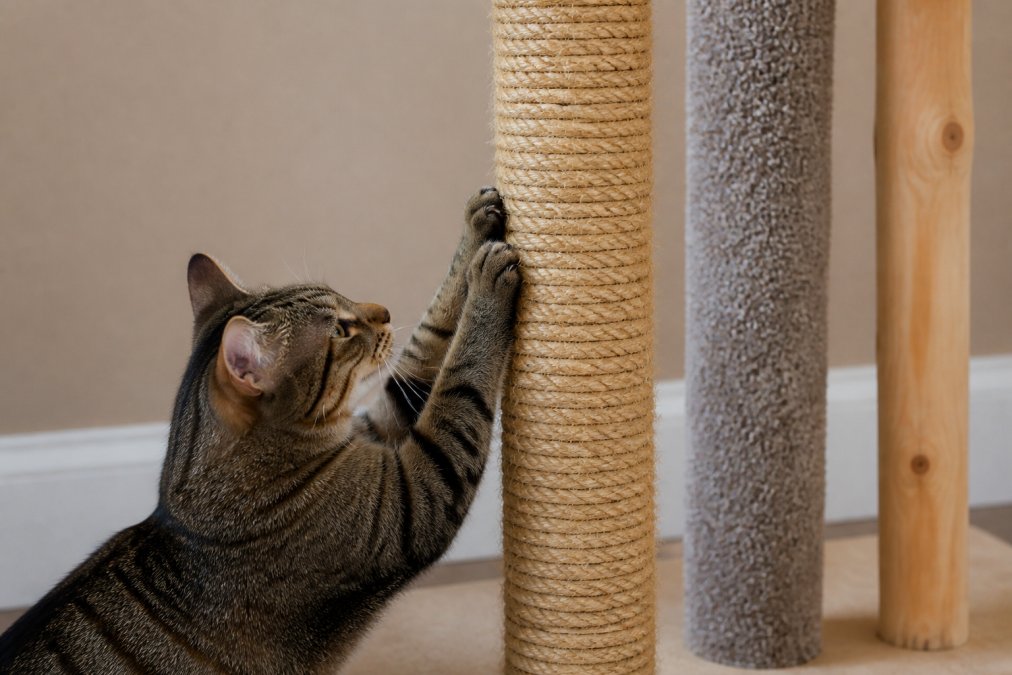
Here's how the three compare in practice:
| Material | Durability | Cat Appeal | Maintenance |
|---|---|---|---|
| Sisal rope | High, lasts years | Strong, satisfies urge | Vacuum loose fibers |
| Carpet | Moderate, mats down | Mixed, mimics furniture | Hard to clean |
| Bare wood | High | Moderate | Wipe with damp cloth |
How Each Material Actually Fails
Durability isn't a single number, it's a failure mode, and each material breaks down differently.
- Sisal rope fails by fraying and loosening. Tightly wound rope sheds individual fibers for months before any strand pulls free; loose, gap-toothed wrapping unravels in weeks because claws catch the gaps instead of the fibers.
- Carpet fails by matting. The pile compresses flat under repeated clawing, and once flat it no longer satisfies the urge, so the cat moves on to your rug. Carpet also traps dander and is the hardest surface to clean.
- Bare wood fails by smoothing. Claws polish the grain over time, and a slick surface stops providing resistance. Soft woods like pine dent and splinter; dense hardwoods hold their texture far longer.
The Eco-Friendly Material Breakdown Most Reviews Skip
"Natural" on a product page tells you almost nothing. Here's what to check, because cats groom their claws with their mouths right after scratching, anything on the surface ends up ingested in trace amounts.
- Sisal fiber: Look for untreated or undyed sisal. Dyed rope can carry residual dye compounds, and heavily bleached fiber loses some roughness. Undyed sisal has a pale, natural tan color.
- Adhesives and glues: The real gap. Rope is glued to the core, and carpet to platforms. Water-based, low-VOC adhesives are safer; solvent-based contact cements off-gas for days after unboxing. If a post smells strongly of chemicals when you open it, that's the adhesive, not the fiber.
- Finishes: On wood frames, water-based finishes beat oil-based polyurethane for indoor use around cats. Untreated or food-safe-oil-finished wood is lowest-risk.
- Recyclability: Sisal rope is compostable and the wood core recyclable, but a post glued together with heavy adhesive usually isn't separable, one more argument for posts with replaceable, rewrap-able scratching surfaces.
Texture and Scratch Angle
Cats scratch both vertically and horizontally, and the surface angle changes which material works. Vertical sisal posts suit cats that rear up and stretch; horizontal sisal pads or a slightly angled board suit cats that scratch low and flat. If your cat scratches the side of the sofa (vertical) versus the top of an ottoman (horizontal), match the post orientation to that habit, the material matters less than giving the cat the angle it already prefers.
Tall Cat Scratching Post for Large Cats: What to Look For
A tall cat scratching post for large cats needs a minimum height of 32 inches, a base wide enough to prevent tipping under a heavier cat, and a post diameter thick enough for big paws to grip. Large breeds like Maine Coons and Ragdolls put more force into every scratch, so undersized posts fail fast.
Weight-Bearing Capacity: The Spec Almost No Product Page Lists
This is the biggest gap in how scratching posts are reviewed. Manufacturers publish height and material, but almost never a weight rating, and weight determines whether a post survives a large cat.
- Under 12 lb (average adult): Most well-built posts hold steady. Base width roughly equal to height is enough.
- 12-18 lb (large domestic): Look for a base wider than the post is tall, or a weighted bottom panel. Thin particle-board bases start to flex here.
- 18 lb and up (Maine Coon, Ragdoll, Norwegian Forest Cat): You need a genuinely heavy base, solid wood or a weighted platform, plus a thick post diameter (4 inches or more) so big paws can grip. This is where most off-the-shelf posts fail.
The Wobble Test You Can Run Before You Buy
Since weight ratings aren't published, test for wobble directly, the closest thing to a real durability metric without owning the post for six months.
- Press down hard on the top platform with one hand while the other holds the base steady. Any flex in the post means the core is too thin.
- Push sideways at the top as if a cat were pulling back mid-scratch. If the base lifts even slightly, a large cat will tip it.
- Check the base material. Solid wood or a weighted panel resists; hollow particle board and thin MDF flex and eventually crack at the mounting points.
- Inspect the hardware. Bolts threading into metal inserts hold far better than screws driven straight into wood, on a heavy cat, screw threads strip out over time.
Long-Term Wear: What Six Months of a Large Cat Actually Does
Most reviews stop at unboxing. The wear pattern on a post used by a heavy cat shows up in a predictable order:
- Months 1-2: Rope fibers loosen slightly at the most-used scratch height. This is normal and doesn't affect function.
- Months 3-6: Base hardware needs attention first. Bolts work loose under repeated sideways force, and a post that felt solid at month one can wobble by month six. Tighten hardware every few months.
- Months 6-12: Rope at the primary scratch zone thins noticeably. Plan to rewrap or replace the scratching surface every year to two years, which is why replaceable pads matter more for large-cat owners than anyone else.
Size and Height for Large Breeds
Measure from the floor to the top of your cat's outstretched front paws, then add a few inches so it can stretch fully without crouching.
- Average adult cats: 24 to 30 inches
- Large breed cats: 32 to 40 inches
- Kittens: start at 20 inches and size up as they grow
Cat Scratching Post Stability Tips to Prevent Tipping
Preventing a post from tipping comes down to base width, weight distribution, and placement. These cat scratching post stability tips apply whether you're buying new or fixing a wobbly post you already own.
- Place the post against a wall to limit backward movement
- Add weight to the base with a sandbag or heavy platform
- Tighten all assembly hardware every few months
- Set it on a non-slip mat or rug to stop sliding
- Choose a corner spot where the post can't be pushed sideways
Top Durable Cat Scratching Posts for 2026
The most durable cat scratching posts for 2026 share three traits: dense sisal wrapping, a wide weighted base, and a height that matches the cat using it. Here are our top picks.
Pure-N-Equal Heavy-Duty Sisal Scratching Post
Our top pick is the Pure-N-Equal Heavy-Duty Sisal Scratching Post. It's built for daily use with tightly wound sisal rope over a solid core, and the wide base keeps it steady even at full stretch.
Pros:
- Dense sisal rope resists shredding
- Wide, stable base
- Replacement pads extend longevity
Cons:
- Heavier than basic posts, so plan its spot before assembly
Pure-N-Equal Tall Cat Tower with Scratching Posts
For multi-cat households and large breeds, the Pure-N-Equal Tall Cat Tower pairs full-height scratching posts with carpeted platforms for perching. The taller design suits cats that stretch vertically.
Pros:
- Tall enough for large breed stretching
- Multiple scratching surfaces
- Carpeted platforms for perching and resting
Cons:
- Takes up more floor space than a single post
Eco-Friendly Materials and Floor Protection: What Competitors Miss
Long-term wear shows up first in the rope, not the frame. Plan to replace or rewrap the scratching surface every year or two on a well-used post, and inspect the base hardware for looseness each season.
Conclusion
Choosing a durable scratching post comes down to matching material, height, and base width to your cat, then protecting your floor and maintaining the post over time. Pure-N-Equal offers thoughtfully selected pet essentials built for daily use, including sturdy scratching posts, replacement pads, and stable cat towers designed to keep indoor cats entertained and your furniture safe.
Frequently Asked Questions
What is the most durable material for cat scratching posts?
Sisal rope is generally the most durable material for cat scratching posts. It withstands repeated scratching better than carpet or cardboard. Look for tightly wound, thick sisal rope (at least 3/16 inch diameter) on a sturdy wooden or PVC core. Natural wood posts are also durable. Avoid carpet-covered posts.
How do I choose a scratching post that won't tip over?
Choose a post with a wide, heavy base. The base should be at least half the height of the post. For tall posts, look for one that can be anchored to the wall or has a weighted base. Check the stability tips section for more: place on a non-slip surface, tighten assembly hardware regularly, and consider a post with a low center of gravity. A wobble-free post encourages your cat to scratch without fear.
Are sisal or carpet scratching posts better for durability?
Sisal rope outlasts carpet in most cases. If you choose carpet, opt for a tight-loop, low-pile carpet to extend its life.
How often should you replace a cat scratching post?
Replace a scratching post when it becomes unstable, the scratching surface is significantly worn, or the post starts shedding material. Signs it's time: excessive wobbling, exposed core, or your cat losing interest.