


Table of Contents
- Why Puppies Pull on the Leash and What It Means
- Choosing the Best Harness for Pulling Puppies
- Puppy Leash Training Tips for the First Two Weeks
- Loose Leash Walking Training: Building Slack and Engagement
- Training Reactive Puppies and Breed-Specific Pulling
- Common Mistakes and How to Stay Consistent
- Frequently Asked Questions
Last Updated: September 14, 2026
Why Puppies Pull on the Leash and What It Means
Puppy leash pulling is not defiance. It is normal puppy behavior driven by instinct, curiosity, and a nervous system that has not yet learned impulse control. At Pure-N-Equal, new owners often assume their puppy is "being stubborn" when the real issue is biology and lack of training.
Puppies explore the world nose-first, and when a leash restricts that urge, they lean into the pressure and pull harder. Opposition reflex is hardwired: push against a dog and the dog pushes back.
Pulling almost always has one of two root causes, and they require different training approaches.
Excitement, Exploration, and Instinct
A puppy that pulls toward the park, a squirrel, or another dog is excited, not aggressive. The fix is engagement training: reward check-ins every few steps so staying near you pays better than dragging you forward. This often resolves the pattern within weeks.
When Pulling Signals Reactivity or Over-Arousal
Some puppies pull because they are overwhelmed. A reactive puppy may lunge, bark, or freeze when it spots a trigger, and the leash tension escalates the arousal. This is not the same problem as an excited puller. Reactive dogs need distance first, then gradual desensitization at a pace the puppy can handle. The American Veterinary Society of Animal Behavior position statement on humane training recommends reward-based methods over aversive tools for exactly this reason.
Choosing the Best Harness for Pulling Puppies
The best harness for pulling puppies is a front-clip design with padded straps and a snug, adjustable fit. The front-clip attachment redirects forward motion sideways, reducing leash tension without choking or pinching the throat.
Back-clip harnesses, the standard style sold in most pet stores, make pulling easier because they distribute pressure across the chest like a sled dog's harness. If your puppy pulls hard, switching to front-clip is often the fastest equipment change you can make.
Front-Clip vs. Back-Clip: What Actually Reduces Leash Tension
| Harness Type | Effect on Pulling | Best For | Watch Out For |
|---|---|---|---|
| Back-clip | Increases use | Calm, already-trained dogs | Encourages pulling in strong puppies |
| Front-clip | Redirects motion sideways | Pullers and training | Needs correct sizing to work |
| Head halter | Controls the head | Severe pullers | Requires slow introduction |
| Training collar | Aversive pressure | Not recommended for puppies | Risk of neck and tracheal injury |
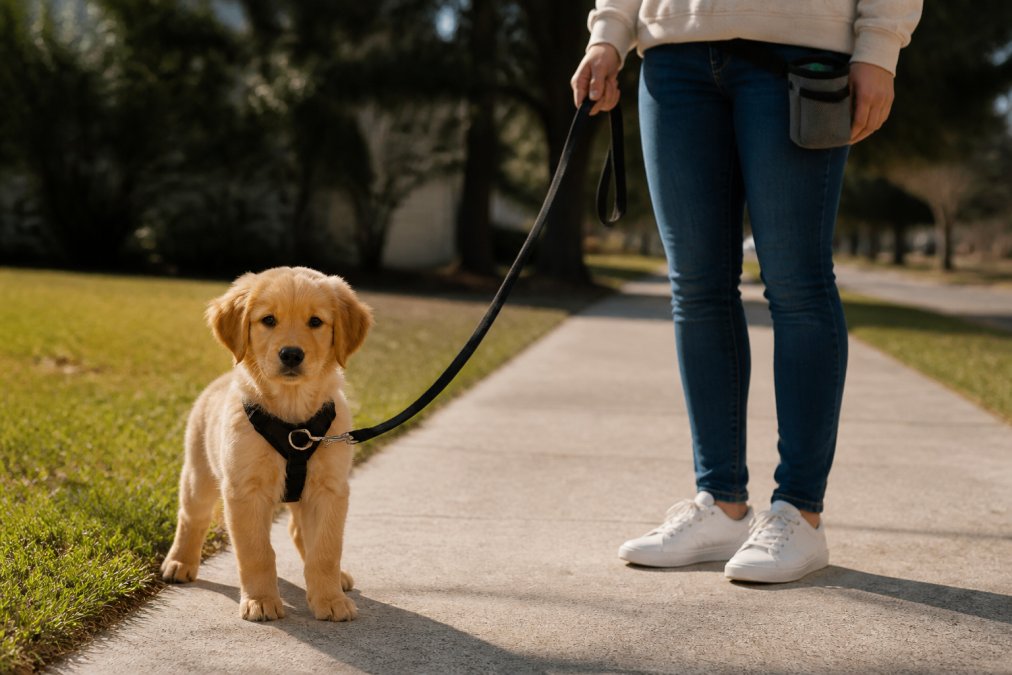
How to Fit a Front-Clip Harness So It Actually Works
A front-clip harness only redirects motion if it sits correctly. Most owners tighten the wrong straps and wonder why it twists sideways when their puppy lunges. Here is the fit check that matters:
- Chest strap: Should sit low across the breastbone, roughly a hand's width below the base of the neck, never up on the throat. If it rides high, the front clip pulls the shoulder sideways instead of redirecting forward motion.
- Girth strap: Snug behind the front legs, with two fingers sliding flat under the strap. Loose enough to breathe, tight enough that the harness does not rotate when tension hits.
- Shoulder clearance: The front leg should move freely without the strap cutting into the armpit. Chafing here is the most common reason puppies start dodging the harness.
- Front clip position: Should sit centered on the chest, not off to one side. An off-center clip causes the puppy to crab-walk.
Check the fit every two to three weeks. Puppies grow fast, and a harness that fit at twelve weeks will be too tight by sixteen. A rubbing harness teaches your puppy that the walk itself is unpleasant, a problem that outlasts the pulling it was meant to fix.
Head Halters: Powerful, but Not a First Choice for Puppies
A head halter controls the head, and where the head goes, the body follows, making it the most mechanically effective no-pull tool available, and the most often misused.
A head halter must be introduced slowly, over days, with treats and short sessions before it ever goes on a real walk. If a puppy fights it, paws at it, or shuts down, the tool is doing more harm than good. Because it puts pressure near the eyes and muzzle, a hard lunge can torque the neck. Most veterinary behavior practitioners reserve head halters for adolescent or adult dogs under professional guidance, not young puppies whose growth plates are still open.
The Equipment Mistake That Undoes Everything
Retractable leashes are the most common equipment error in puppy training. They reward pulling with more freedom, the opposite of what you are teaching, and keep constant light tension on the line. Swap it for a fixed-length six-foot leash before any loose-leash work.
Pure-N-Equal's No-Pull Tactical Dog Harness is built from 1050D nylon with both front and rear metal leash attachment points, so you can start on the front clip for training and move to the back clip once your puppy walks politely. The padded construction and breathable mesh matter more than most owners realize, because a harness that rubs will make your puppy avoid the walk altogether.

Puppy Leash Training Tips for the First Two Weeks
The first two weeks set the tone. Keep sessions to five or ten minutes, twice a day, and end while your puppy is still succeeding. Short, frequent puppy leash training tips beat one long frustrating walk every time.
Start Indoors: Low-Distraction Environments First
Begin in a hallway or living room where there is nothing exciting to chase. Walk a few steps, reward your puppy for staying beside you, and stop. Once your puppy can walk ten steps on a loose leash indoors, move to a backyard, then a quiet sidewalk, then a park. Each new environment resets the difficulty.
The Stop and Wait Method, Step by Step
- Hold the leash with slack, not tension.
- The moment your puppy pulls, stop moving and stand still.
- Wait, without tugging, until your puppy turns back or the leash goes slack.
- Mark the slack with a "yes" and reward with a high-value treat.
- Resume walking. Repeat every time tension appears.
The stop and wait method works because it removes the reward of forward motion. A puppy that pulls gets nothing; a puppy that returns to you gets treats and progress. Most puppies grasp the pattern within a week of consistent practice.
Loose Leash Walking Training: Building Slack and Engagement
Loose leash walking training is the long game. The goal is not a robotic heel but a puppy that chooses to stay near you because that is where the rewards live. Expect weeks, not days, and regression during adolescence.
Marker Training and High-Value Treats
Marker training uses a consistent sound, a clicker or a word like "yes," to tell your puppy exactly which behavior earned the reward. The marker must come within a second of the behavior, or the puppy connects it to the wrong thing. Pair it with high-value treats: real chicken, cheese, or freeze-dried liver, not kibble.
Redirection vs. Leash Correction
Redirection means changing your puppy's focus before the pull happens: a treat tossed on the ground, a quick turn, a cheerful "let's go." Leash correction means applying a physical jerk to stop the behavior. Modern training guidance, including the American Kennel Club's training resources, favors redirection because it teaches the puppy what to do instead of only what to stop. For puppies, whose necks and tracheas are still developing, correction-based tools carry real injury risk.
Training Reactive Puppies and Breed-Specific Pulling
Not every puppy pulls for the same reason, and the training plan has to match the cause. A Husky pulling toward a scent trail and a fearful puppy pulling away from a stranger look identical on the leash but need opposite approaches.
Match the Protocol to the Breed Drive
Breeding selected for specific jobs, and that shows up on the leash. Grouping puppies by drive level gives you a faster starting point than a one-size-fits-all plan.
High-drive working and herding breeds, Huskies, Malamutes, Border Collies, Australian Shepherds, German Shepherds, and most retrievers. Bred to move forward, chase motion, and work at a distance from a handler, these puppies pull by default. They need:
- A structured job before the walk, a five-minute obedience drill, a food-scatter in the yard, or a tug session with clear start and stop cues
- Impulse-control games like stay-and-release, "leave it," and waiting at doorways
- A front-clip harness from day one, because a flat collar will not hold a determined adolescent Husky
- Shorter walks with more training reps; a tired body does not equal a trained brain
Terriers and scent hounds, Beagles, Basset Hounds, Dachshunds, and most terrier breeds. These puppies pull nose-first. The trigger is smell, not speed. They respond best to:
- "Find it" games that let them use their nose on your terms
- Rewarding check-ins heavily, because eye contact competes with scent
- Training in areas with fewer scent trails at first, then adding distraction
Toy and companion breeds, Chihuahuas, Pomeranians, Cavalier King Charles Spaniels, and similar. These puppies often pull from excitement or over-handling, not drive, and respond quickly to stop-and-wait because forward motion is the reward they want most. Watch for collar pressure on tiny tracheas, a harness is almost always better.
Giant and guardian breeds, Great Pyrenees, Mastiffs, Newfoundlands. Bred to make independent decisions, these puppies may pull because they are patrolling, not because they are untrained. Early, consistent loose-leash work matters more here than in any other group, because a hundred-pound adolescent that was never taught leash manners is a genuine safety problem.
Excitement Pulling vs. Fear-Based Reactivity
These two pull for different reasons.
Common Mistakes and How to Stay Consistent
The biggest mistake owners make is inconsistency. If pulling works sometimes, it persists, because intermittent reinforcement is the strongest kind. Everyone in the household has to follow the same rules on every walk.
Other common errors:
- Using a retractable leash, which teaches your puppy that pulling extends the walk
- Practicing only on real walks instead of short training sessions
- Skipping the reward because "the puppy should just know"
- Walking too far, too soon, so the puppy never succeeds
- Switching equipment every week instead of giving one method time to work
Consistency and patience matter more than any single tool. A puppy that gets the same response every time learns the rule fastest.
Pure-N-Equal's Gradient Dog Training Leash is built for this work: a six-foot nylon rope with metal hardware that gives you enough length to reward a check-in without letting your puppy drift to the end of a retractable line. Pair it with a properly fitted harness, and you have the two pieces of equipment that actually move the needle.

Frequently Asked Questions
How long does it take to train a puppy to stop pulling on the leash?
Most puppies show real improvement in 4 to 8 weeks with daily 10 to 15 minute sessions. Some take longer, especially high-drive breeds or puppies past 6 months. The biggest factor is consistency: every walk is a training walk. If you allow pulling sometimes and correct it other times, the behavior sticks around much longer. Short, frequent sessions beat one long weekly session every time.
Should I use a harness or a collar to stop puppy leash pulling?
A front-clip harness is the safer choice for puppies. It redirects forward motion to the side without putting pressure on the neck and trachea, which matters for growing dogs. Collars can work for mild pullers, but a puppy that lunges or bolts can hurt itself on a flat collar. Look for a padded harness with both front and rear leash attachment points so you can switch as training progresses.
Why does my puppy pull on the leash when they see other dogs?
That is usually over-arousal or frustration, not disobedience. Your puppy wants to greet the other dog and has not learned that pulling gets them nowhere. The fix is distance: work below your puppy's distraction threshold, reward calm behavior with high-value treats, and gradually close the gap. If your puppy barks, lunges, or freezes, you are too close. Back up and try again.
What commands stop leash pulling?
Three commands do most of the work: a heel or "with me" cue for walking position, a "watch me" cue to build engagement, and a "let's go" cue for changing direction when your puppy locks onto something. Pair each with marker training (a clicker or a verbal "yes") and reward immediately. Practice each command indoors first, then in the yard, then on quiet sidewalks before trying them on busy streets.